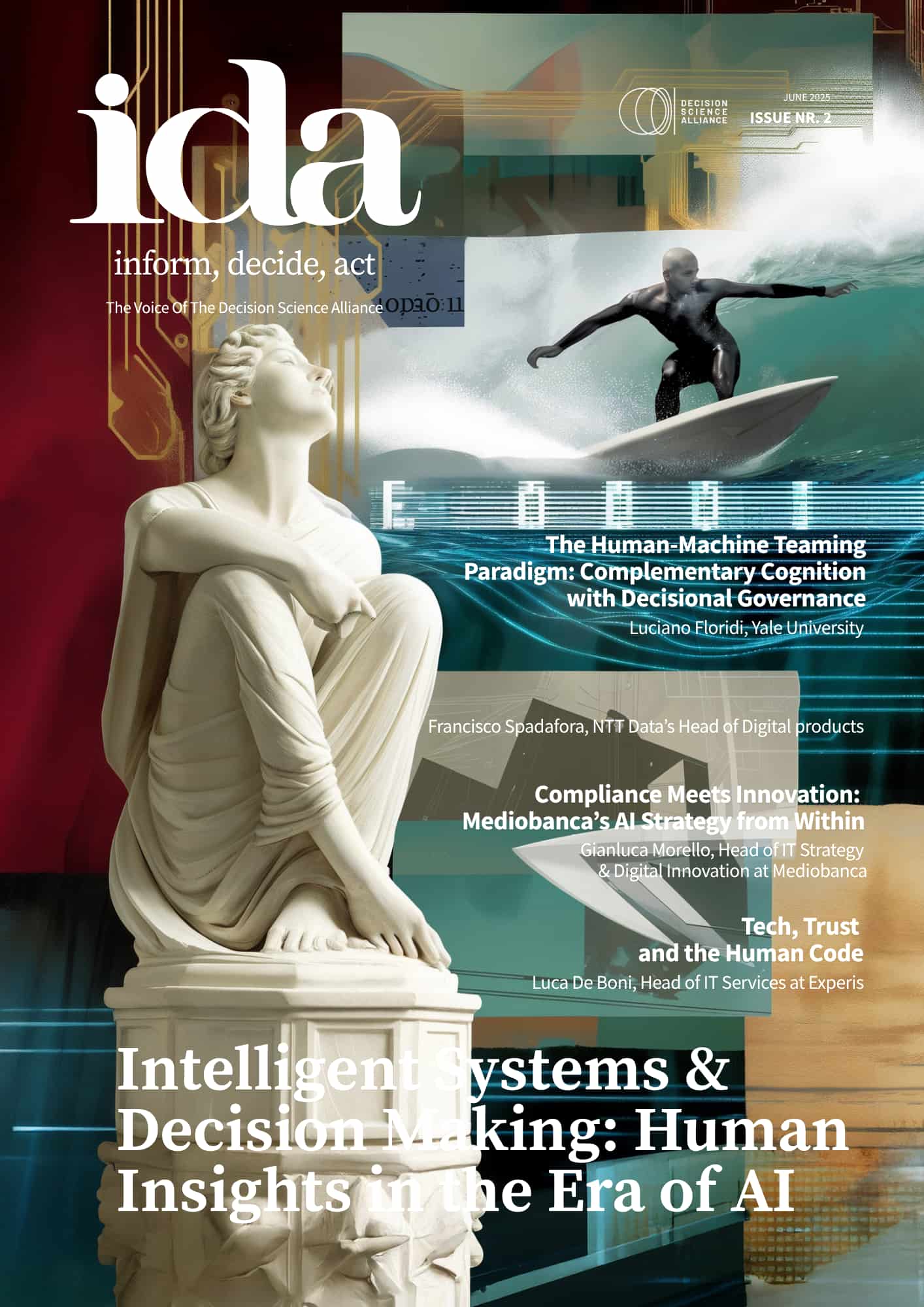
Intelligent Systems & Decision Making: Human Insights in the Era of AI
The second issue of IDA Magazine showcased how decision science is transforming industries and driving progress, delving into topics such as Bayesian probability, predictive analytics, and the convergence of decision science with digital transformation.
This edition was officially presented at the Third International Summer Conference in Catania on June 19–20, 2025.
The Human-Machine Teaming Paradigm: Complementary Cognition with Decisional Governance Luciano Floridi, Yale University
Compliance Meets Innovation: Mediobanca’sAI Strategy from Within Gianluca Morello, Head of IT Strategy & Digital Innovation at Mediobanca
Building Identity in Motion: Alessandro Orsinion Fashion, Tech, and Intuition Alessandro Orsini, CEO and co-founder of Subdued
Bridging Research and Reality:Tommaso Colombo on AI That Matters Tommaso Colombo, Head of AI at Spindox
Thinking, Deciding, Acting: ASustainable Vision for Change Paolo Mamo, President atnow leads the Planet Life Economy Foundation
Designing Change: Futures Thinking& the Art of Choice Federico Rivera, Chief Design Officer at Sketchin
Practicing Excellence.AI, Blockchain and Beyond Francisco Spadafora, NTT Data’s Head of Digital products
Narrating Culturein a Digital Age Luca Melchionna, founder of Machineri
Intuition in Action: Elena Meneghettion Embodied Decision-Making Elena Meneghetti, Executive Coach & Elemens CEO
AI and Negotiation: RethinkingDecision-Making in Procurement Camilla Borsani, PhD Milan Polytechnic University
The Relevance of Artificial Intelligence forDecision-Making in Manufacturing Emanuele Carpanzano, SUPSI and DSA Co-Founder
Tech, Trustand the Human Code Luca De Boni, Head of IT Services at Experis
Narrating Innovation: AI and Cross-Disciplinary Collaboration Andrea Calcagni, Automation and AI Performance Manager
Tailoring Compliance Before AIWalks The Runway Enrico Dessì, Growth Director, Limitless Innovation
Driving Industry 4.0 Forward: The IoT PioneerBehind B4 Digital Industries Angelo Tracanna, CEO & Founder B4
Welcome to the New Edition of IDA, guided by its key voices
LETTER FROM THE EDITOR
Rethinking Authority: Creativity and Decision-Making in the Age of Intelligent Systems
Decision-making is an art long practiced in the shadows—where insight often hides behind instinct, and complexity resists reduction. But in this third issue of IDA Magazine, we shift the frame once again, this time to explore a new kind of visibility: the one offered by intelligent systems that not only inform decisions, but help define the very way we imagine, choose, and create.
I’m proud to share that this issue marks a few significant milestones for the IDA platform. First, we are honoured to welcome Professor Luciano Floridi among our contributors. One of the world’s most rigorous and visionary thinkers on the philosophy of information and AI ethics, Floridi reminds us that technology without conceptual clarity is a dangerous fiction. His contribution invites us to rethink not only what we decide—but how we define decision-making in an AI-mediated world.
Second, with this edition we officially launch The Node, our new podcast dedicated to the voices shaping tomorrow’s decisions. In each episode, we sit down with leaders from technology, business, academia, and design—those who aren’t just reacting to change, but composing it. These conversations expand the magazine’s mission into a new auditory space: one where nuance, personality, and context come alive. We also celebrate this issue as the editorial companion to our International Summer Conference, hosted this year in the electric heart of Sicily: Catania. As Mediterranean as it is technopolitical, the city is the ideal backdrop for a gathering that questions the speed, ethics, and depth of our digital turn. Expect not just panels and keynotes, but moments of real friction—and fertile collision.
We also celebrate this issue as the editorial companion to our International Summer Conference, hosted this year in the electric heart of Sicily: Catania. As Mediterranean as it is technopolitical, the city is the ideal backdrop for a gathering that questions the speed, ethics, and depth of our digital turn. Expect not just panels and keynotes, but moments of real friction—and fertile collision.
This issue’s theme—AI as a new paradigm for creativity and decision-making—is no coincidence. It reflects a turning point. AI is no longer a tool to be adopted. It is becoming a collaborator—one that influences the way we think, draft, predict, and even feel. From design to logistics, governance to storytelling, decisions are increasingly co-authored by machines. The question is no longer “Will AI change creativity?” It is: What kind of creativity do we now need to cultivate in order to remain human in the loop?
As always, IDA exists at the intersection of systems and stories. This edition maps a territory where algorithms meet ethics, aesthetics meet data, and decision science becomes an invitation to rethink what it means to act, lead, and imagine. Welcome to Issue No. 2.
Luca Lisci IDA Magazine Editor-in-Chief and DSA Editorial Department Director
Luca Lisci, a seasoned innovator with over 30 years of experience, excels in blending ethical technology use with human development. As a multifaceted entrepreneur, journalist, and educator, he focuses on design strategy, ethical innovation, breakthrough tech, branding and identity. His expertise extends to AI, design thinking, and digital strategy, with notable involvement in the art and creative industries, showcasing a dynamic approach to leveraging technology for cultural advancement and sustainable growth.
LETTER FROM THE PUBLISHER
Recalibrating the Compass: Decision Science for a World in Acceleration
We are living in a paradoxical time — one both exhilarating and uncertain. For those of us immersed in technology and research, the pace of innovation offers extraordinary opportunities. New ideas are not merely emerging; they are shaping and reshaping our lives at an accelerating speed. From breakthroughs in AI to novel economic models, the landscape is brimming with promise.
Yet, alongside this technological fervor, we face profound turbulence. Social and political systems often struggle to adapt to rapid transitions. A shifting geopolitical order and mounting pressures on financial institutions add complexity to our already volatile global stage.
In this context, whether we are acting as professionals, citizens, researchers, or decision-makers, we are challenged to ask ourselves: what are our anchor points? What remains steady amid the flux?
A fundamental cornerstone is humanity’s capacity to collaborate — to elevate one another through shared purpose and mutual advancement. Culture shapes our views and narratives, often creating subjective lenses through which we perceive the world.
Yet beneath these filters lies a shared human trait: empathy, the quiet but resilient gene that binds us. It fuels our will to support one another, to progress together. Decision-making is the practical manifestation of this collaborative spirit. It is the method by which we transform uncertainty into action — across personal choices, organizational strategies, and public policy. At its core, decision-making is an iterative cycle: prediction, action, evaluation, correction. Prediction guides us to anticipate outcomes based on our understanding of the future. Action embodies our intent — the mechanism by which we seek to influence that future. Evaluation helps us assess whether our actions yield expected results. Correction allows for adaptation — refining our approach when outcomes deviate from expectations. This cycle operates across all domains — from autonomous systems like self-driving cars, to retail pricing algorithms, to legislative reforms seeking societal impact. Decision science, therefore, becomes not just a field of study, but a framework for resilience and adaptation in the modern world.
In the new technological landscape, the cooperation between human intelligence — grounded in consciousness and ethical awareness — and computational intelligence — endowed with immense processing power — defines the next frontier of evolution. The ability to model systems and processes, and to design and implement decision-support architectures, is more crucial than ever. This extends beyond data-driven learning: it includes all formal techniques that allow us to describe, analyze, and improve complex systems — even social structures and human interactions. The adoption of artificial intelligence has now become pervasive. It transforms the way we govern and manage systems — from the vehicle we drive, to the hospitals where we seek care, to factories, retail networks, and public administrations. This transformation demands not only new tools but a gradual and profound rethinking of our entire IT architectures and decision-making paradigms. For example, a hospital adopting AI for diagnosis and treatment must go beyond installing an algorithm. It must re-architect how data flows between departments, how decisions are validated, and how accountability is structured — ensuring transparency, ethical safeguards, and dynamic learning capabilities are embedded throughout the system. This is the very essence of our mission at the Decision Science Alliance: to support this transition — technically, ethically, and socially — both in the private sector and at public institutional levels. We are not only accompanying change; we are co-architecting the decision-making infrastructures that will shape the future.
Raffaele Maccioni IDA Publisher Director and DSA President & Co-Founder
Raffaele Maccioni is an entrepreneur-manager focused on building initiatives from research to create tangible market value. Electronic – Control Engineer from the Polytechnic of Milan. Over 25 years of experience and passion for analytical models and algorithms applied to complex systems. Raffaele is now leading and supporting as R&D Executive a few companies and entrepreneurship initiatives.